NUMBERS
Journey: Faith Tested in the Wilderness
BRIEF INTERPRETATION
1. Summary of the Book
After God teaches Israel how to live as a holy people, the journey toward the Promised Land begins. The Book of Numbers tells the story of this long and difficult journey through the wilderness, a journey marked by faith, failure, patience, and God’s enduring mercy.
God instructs Moses to take a census of the people. The tribes of Israel are counted and organized, not as slaves anymore, but as a people on the move, guided by God. The Tabernacle remains at the center of their camp, showing that God dwells among them and leads their steps. Whenever the cloud of God’s presence moves, the people move; when it rests, they camp.
As the journey unfolds, the people quickly begin to complain. They grumble about food, water, and the hardships of the desert. They grow tired of manna, the daily bread God provides, and long for the comforts of Egypt, forgetting the slavery they left behind. Moses feels overwhelmed by the burden of leadership, and God appoints seventy elders to share the responsibility with him.
The greatest failure comes when Israel reaches the edge of the Promised Land. Moses sends twelve spies to explore the land. Though the land is rich and fertile, ten of the spies spread fear, saying the inhabitants are too strong. Only Joshua and Caleb trust God and urge the people to move forward. The people listen to fear instead of faith and refuse to enter the land.
Because of this lack of trust, God declares that the generation that left Egypt will wander in the wilderness for forty years. Only their children—and Joshua and Caleb—will enter the Promised Land. This moment becomes a turning point: a journey that could have taken weeks stretches into decades.
Throughout these years, the people continue to struggle. There are rebellions, including the uprising led by Korah, who challenges Moses’ authority. There are moments of impatience, such as when Moses strikes the rock in anger instead of speaking to it as God commanded. Even Moses suffers consequences, being told that he will not enter the Promised Land himself.
Yet again and again, God shows mercy. He provides water, protects the people from enemies, and even turns curses into blessings through the strange story of Balaam, who is hired to curse Israel but can only bless them because God is with His people.
As the forty years come to an end, a new generation rises—one shaped by the wilderness but still chosen by God. A second census is taken, showing that despite death and failure, God’s people endure. The journey brings them once again to the edge of the Promised Land, filled with hope and readiness.
The Book of Numbers reveals a God who remains faithful even when His people are not. It shows that unbelief delays blessing, but God never abandons His plan. The wilderness becomes a place of testing, discipline, and growth, preparing Israel for the future God has promised.
2. Author
Traditionally attributed to Moses, who recorded Israel’s experiences, laws, and divine encounters during the wilderness journey. Catholic tradition upholds him as the principal human author of the Pentateuch through divine inspiration.
3. Time of Composition
The events span roughly forty years in the wilderness. Written or compiled near the end of Moses’ life, traditionally in the 13th or 15th century BC, depending on the chronology used.
4. Intended Audience
The people of Israel—especially the generation preparing to enter the Promised Land. Numbers instructs them to avoid the unbelief of their ancestors and to trust in God’s promises with renewed faithfulness.
5. Major Themes
God’s faithfulness and human rebellion
The necessity of trust and obedience
Leadership and intercession
Holiness in worship and daily life
Divine guidance through the cloud and fire
Judgment, mercy, and discipline
Formation of a new covenant generation
The spiritual meaning of pilgrimage
6. Section-Wise Division
A. Preparation at Sinai (Nm 1–10)
First census (Nm 1)
Arrangement and camp order (Nm 2)
Duties of the Levites (Nm 3–4)
Purity and restitution laws (Nm 5–6)
Offerings of tribal leaders and lampstand instructions (Nm 7–8)
Passover observance (Nm 9:1–14)
Departure from Sinai guided by the cloud (Nm 9:15–10:36)
B. Rebellion and Wandering (Nm 11–20)
Complaints and quail (Nm 11)
Miriam and Aaron oppose Moses (Nm 12)
Spies sent into Canaan and the people’s rebellion (Nm 13–14)
Korah’s rebellion (Nm 16)
Aaron’s budding staff (Nm 17)
Laws for priests and Levites (Nm 18)
Water from the rock and Moses’ failure (Nm 20)
Deaths of Miriam and Aaron (Nm 20)
C. Toward the Promised Land (Nm 21–36)
Bronze serpent (Nm 21:4–9)
Defeats of Sihon and Og (Nm 21:21–35)
Balaam’s prophecies (Nm 22–24)
A second census (Nm 26)
Inheritance laws and daughters of Zelophehad (Nm 27; Nm 36)
Joshua appointed leader (Nm 27:12–23)
Offerings and festivals (Nm 28–29)
Vows (Nm 30)
War against Midian (Nm 31)
Settlement east of the Jordan (Nm 32)
Stages of Israel’s journey (Nm 33)
Boundaries of the land and Levitical cities (Nm 34–35)
7. Historical and Biblical Background
Numbers fits within the broader story of Israel’s formation. After being liberated from Egypt and receiving the covenant at Sinai, Israel needed to be shaped spiritually and morally into a people capable of trusting God. The wilderness setting mirrors the interior struggle of the human heart—a place of testing, purification, and transformation.
The book also reflects authentic ancient tribal organization, priestly structures, military mustering, and desert travel methods. It shows Israel interacting with real historical groups such as the Amalekites, Midianites, Moabites, and Amorites. In the biblical narrative, Numbers bridges the covenant formation of Exodus and Leviticus with the final preparation for the land in Deuteronomy.
8. Biblical Flow of Each Section
Preparation at Sinai
Israel is formed into a structured community under God’s presence and prepared to march toward the promise (Nm 1–10).
Rebellion and Wandering
Fear and unbelief cause the first generation to forfeit their inheritance, leading to decades of discipline (Nm 11–20).
Toward the Promised Land
A new generation emerges, receives renewed instruction, and experiences early victories as they prepare for Canaan (Nm 21–36).
9. Orientation to Jesus Christ
Numbers anticipates Christ in many ways.
The bronze serpent lifted up by Moses points to Christ lifted up on the cross (Jn 3:14–15).
Moses’ intercession foreshadows Christ the perfect mediator (Heb 3:1–6).
The manna and water from the rock point to Christ the Bread of Life and the Living Water (Jn 6; 1 Cor 10:4).
The priesthood and sacrifices prefigure Christ’s eternal priesthood (Heb 7–10).
Joshua, who will lead Israel into the land, prefigures Christ who brings His people into the true rest (Heb 4:8–11).
God’s faithfulness despite Israel’s rebellion prepares for the fullness of grace revealed in Christ.
10. Message for Us Today
Numbers teaches that the journey of faith involves struggle, temptation, patience, and growth. Grumbling and fear hinder progress, while trust and obedience bring blessing. God disciplines with love and guides with unfailing presence. The book reveals that every believer is on a spiritual pilgrimage: God goes before us, walks beside us, and shapes us through the trials of life. Numbers encourages perseverance and confidence in God’s promises.
11. Prayer
Lord God of our journey, You guided Israel through the wilderness and shaped them into Your people. Guide me through every challenge and strengthen me to trust in Your promises. Free me from fear and unbelief, and teach me to walk with faith, gratitude, and obedience. May the lessons of Numbers draw me closer to Jesus, my mediator and guide. Amen.
SECTION-WISE INTERPRETATION
1. THE CENSUS AND THE ARRANGEMENT OF THE CAMP (NUMBERS 1–4)
Introduction
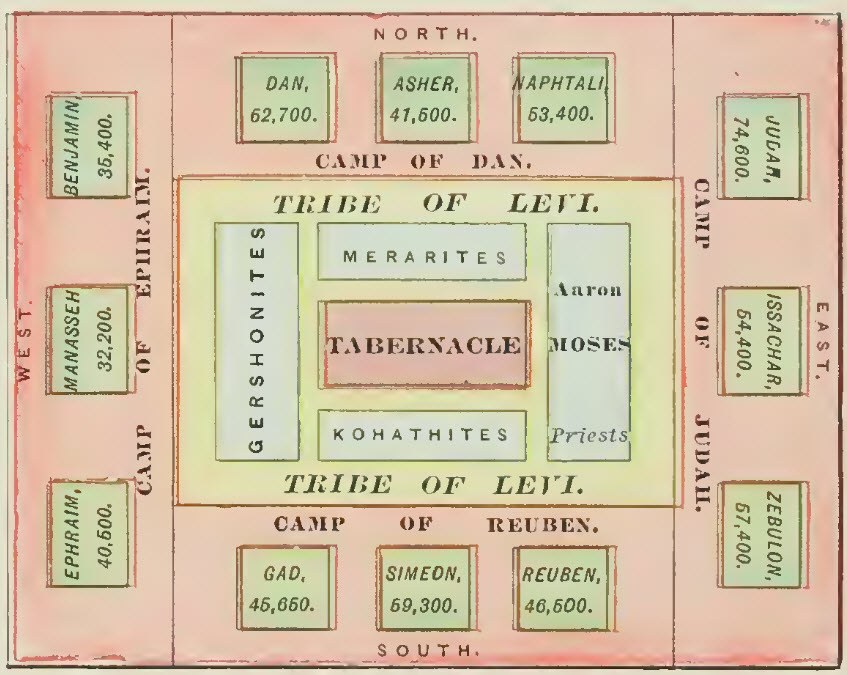
The Book of Numbers opens with a command for order. One month after the Tabernacle was completed, God instructs Moses to take a census of the men of Israel who are able to go to war. This is not merely a bureaucratic exercise; it is the transformation of a group of former slaves into a sacred army. By counting them “by their names” and “by their clans,” God shows that His people are organized, protected, and personally known to Him.
In the Catholic Bible, this section illustrates the ecclesial order of the Church. Just as the tribes were arranged with the Tabernacle at the center, the life of the Christian is meant to be Christ-centered, with the Eucharist at the heart of the community. It teaches that every member of God’s people has a specific place and responsibility. The detailed duties of the Levites remind us that service in God’s house is a holy burden requiring preparation, reverence, and obedience.
Summary
The first census (chapter 1) records 603,550 men aged twenty and older, excluding the Levites. Each tribe is assigned a leader and a fixed position in the camp layout (chapter 2). The camp forms a perfect square, with three tribes on each side. At the very center stands the Tabernacle, surrounded by the priests and the three families of the Levites (chapter 3).
Chapters 3 and 4 focus on Levitical service. The Levites are taken in place of the firstborn of Israel to serve at the sanctuary. They are divided into three groups: the Kohathites, who carry the most holy objects; the Gershonites, who transport the curtains and coverings; and the Merarites, who bear the frames, pillars, and bases. God gives strict warnings that even the Levites must not touch the holy objects directly, underscoring the seriousness and danger of approaching the holy without proper reverence.
Key verses
“The Israelites shall camp each in his own division, under the banner of his ancestral house… around the tent of meeting.” (Numbers 2:2)
“The Lord said to Moses: ‘Take the Levites… and they shall perform the service of the Israelites at the tent of meeting.’” (Numbers 3:6–7)
“But they shall not go in to look at the holy things even for a moment, lest they die.” (Numbers 4:20)
“The Kohathites… shall carry these things, but they must not touch the holy things, or they will die.” (Numbers 4:15)
Parallels in Scripture
• Luke 10:1–12 — Jesus appoints the seventy-two disciples, reflecting structured mission and order
• 1 Corinthians 14:40 — “Everything should be done decently and in order”
• Revelation 21:12–13 — The New Jerusalem arranged by the twelve tribes
• 1 Peter 2:5 — Believers as living stones built into a spiritual house
Key words
• census (pequddah): counting as appointment to service
• banner (degel): sign of identity and direction
• redemption price: acknowledgment that life belongs to God
• burden (massa): ministry as both privilege and weight
Historical background
The arrangement of the camp resembles Egyptian military camps, yet with a crucial difference: the Tabernacle is placed at the center not to exalt a human ruler, but to show that God Himself dwells among His people. The Levitical system required discipline and coordination, especially in dismantling and transporting the Tabernacle, highlighting the logistical and spiritual demands of Israel’s worship during their wilderness journey.
Jewish and Catholic traditions
Jewish tradition associates the four main tribal banners with the four living creatures of Ezekiel’s vision. Catholic tradition, reflected in the Catechism, sees the three Levitical families as foreshadowing the three degrees of Holy Orders. The Church Fathers often interpreted the camp’s structure symbolically, as the proper ordering of the soul around God as its center.
How it leads to Jesus Christ
The ordered camp prefigures the Church of Christ. Jesus stands at the true center of God’s people. The census points forward to the Good Shepherd who calls His sheep by name. The Levites carrying the Tabernacle anticipate the disciples carrying the Gospel to the nations. As the Kohathites bore the holy vessels on their shoulders, Christ bore the cross for the salvation of the world.
Conclusion
Numbers 1–4 reveals that God is a God of order and purpose. Holiness requires structure, obedience, and reverence. No one is insignificant; every person has a role in God’s plan.
This section reminds us that closeness to God is a gift that demands respect. The census shows that in God’s kingdom no one is anonymous, and each believer is called to participate in the mission of His people.
Message for us today
We are called to discover our place within the Church, using our gifts for the common good. Respect for God-given order protects unity and mission. Today’s message is that God has counted you by name and entrusted you with a purpose—accept your calling and carry your holy burden faithfully.
Prayer
Lord God of hosts, You who call each star by name, we thank You for the order and unity of Your people. Keep You at the center of our lives and help us fulfill our responsibilities with faith and humility. Lead us together toward the promised dwelling of Your presence. Amen.
2. PURITY OF THE CAMP AND THE NAZIRITE VOW (NUMBERS 5–6)
Introduction
Now that the camp is organized, God provides laws to ensure its spiritual and moral purity. Because the Holy God dwells in the center of the camp, any defilement—whether physical, social, or spiritual—must be addressed. This section covers the removal of the unclean, the law of restitution, and the unique “trial of jealousy.” It concludes with the laws of the Nazirite vow, a path for laypeople to attain a heightened state of consecration.
In the Catholic Bible, these chapters emphasize that holiness is a lifestyle, not merely a ritual. The Nazirite vow shows that God calls not only priests but also laypeople to radical devotion. The Priestly (Aaronic) Blessing at the end of chapter 6 is among the most ancient and beautiful prayers in Scripture and is still used in the liturgy to invoke God’s protection and peace upon the faithful as they are sent forth on mission.
Summary
Chapter 5 opens with the command to remove anyone who is ritually unclean from the camp so that God’s dwelling is not defiled. This is followed by the law of confession and restitution: when someone wrongs another, they must confess and repay the full amount plus a one-fifth penalty. A difficult and often misunderstood passage follows—the ordeal of jealousy—in which a woman suspected of adultery drinks “bitter water.” Historically, this functioned as an appeal to divine judgment that often protected women from baseless accusations by removing the matter from human vengeance.
Chapter 6 introduces the Nazirite vow (from nazir, “consecrated”). Any man or woman could take this vow for a period of time, abstaining from wine and grapes, letting the hair grow, and avoiding contact with the dead. It was a voluntary “spiritual fast” that marked total dedication to God. The section concludes with the Aaronic Blessing, through which the priests “place the name of the Lord” upon the people, invoking light, grace, and peace.
Key verses
“The Lord said to Moses: ‘Command the Israelites to expel from the camp every leper… so that they do not defile their camp, where I dwell.’” (Numbers 5:1–3)
“When a man or woman commits any of the sins against others… they shall confess the sin they have committed and make full restitution.” (Numbers 5:6–7)
“If any man or woman makes a special vow, a Nazirite vow, to set himself apart for the Lord, he shall abstain from wine and strong drink.” (Numbers 6:2–3)
“The Lord bless you and keep you! The Lord let his face shine upon you and be gracious to you! The Lord look upon you kindly and give you peace!” (Numbers 6:24–26)
Parallels in Scripture
• Judges 13:5 — Samson as a lifelong Nazirite
• Luke 1:15 — John the Baptist living a Nazirite-like consecration
• Acts 21:23–26 — Paul’s participation in Nazirite vows
• 2 Corinthians 6:17 — “Be separate,” echoing camp purity and consecration
Key words
• restitution: restoring what was broken; repentance made concrete
• Nazirite: one “set apart”; the hair as a sign of consecration
• bitter water: earthly reality placed under divine judgment
• shalom (peace): wholeness, harmony, and well-being before God
Historical background
The “trial of jealousy” is the only instance of a trial by ordeal in the Mosaic Law. Unlike pagan ordeals, it relied on God’s judgment, not physical harm. The Nazirite vow offered a “democratized holiness”: while priesthood required birth into Levi, anyone could freely choose a life of extraordinary dedication to the Lord.
Jewish and Catholic traditions
Jewish tradition sees the dust used in the ordeal as a reminder of humility—human beings are formed from the earth. Catholic tradition understands the Nazirite vow as a foreshadowing of the evangelical counsels (poverty, chastity, obedience). The Church Fathers frequently interpreted the threefold Aaronic Blessing as a Trinitarian pattern pointing toward the fullness of revelation.
How it leads to Jesus Christ
These chapters point toward the consecration of Christ. Jesus embodies perfect holiness and separation unto God. His fasting from the fruit of the vine during His Passion echoes Nazirite discipline. The restitution laws prefigure Christ, who paid the debt of sin we could not repay. Above all, Jesus Himself is the living fulfillment of the Priestly Blessing—the true Face of God shining upon humanity and granting peace.
Conclusion
Numbers 5–6 teaches that God’s dwelling among His people requires moral integrity, fidelity, and accountability. It shows that God honors voluntary acts of deeper dedication and desires a community that reflects His holiness.
The section ends not with punishment, but with blessing. This reveals God’s heart: His ultimate desire is not condemnation, but to keep, guard, and bless His people.
Message for us today
We are called to live with a “Nazirite spirit,” willingly setting aside comforts or habits that distract us from God. We must practice real repentance through restitution and reconciliation. Today’s message is that God longs to lift up His countenance upon you—live in a way that reflects the light of His face to the world.
Prayer
Lord God, You who dwell among Your people, we thank You for the gift of Your blessing. Purify the camp of our hearts and help us live as consecrated ones in the midst of the world. May Your face shine upon us, and may we walk always in the shalom that comes from You alone. Amen.
3. THE OFFERINGS OF THE LEADERS AND THE CONSECRATION OF THE LEVITES (NUMBERS 7–8)
Introduction
This section details the final preparations for the journey from Sinai. After the Tabernacle is anointed and the camp organized, the leaders of the tribes bring their dedication offerings. This is followed by the formal consecration of the Levites, who are purified to stand in the place of the firstborn of Israel. It is a moment of total communal investment in the worship of God, ensuring that both the materials for the journey and the ministers of the sanctuary are ready.
In the Catholic Bible, these chapters emphasize the importance of lay leadership and the sacramental character of those set apart for ministry. The repetitive listing of the leaders’ identical gifts teaches us that in God’s eyes every tribe’s contribution is equally valuable. The cleansing of the Levites, involving the shaving of the body and the washing of clothes, prefigures the interior purification required for the sacrament of Holy Orders. It teaches us that to serve the Holy One, one must be offered to God as a living sacrifice.
Summary
Chapter 7 records the dedication offerings brought by the twelve tribal leaders over twelve days. Each leader presents identical gifts: silver plates and bowls filled with fine flour and oil, gold ladles of incense, and animals for burnt, sin, and peace offerings. These offerings provide for the altar and the sanctuary. God accepts these gifts and speaks to Moses from the mercy seat, between the cherubim, confirming His dwelling among His people.
Chapter 8 turns to the menorah and the Levites. Aaron is commanded to set the seven lamps so that they give light toward the front of the lampstand. The Levites are then purified: they are sprinkled with water, shave their entire bodies, and wash their garments. The Israelites lay their hands on them, presenting them as a wave offering to the Lord in place of the firstborn. The chapter concludes by establishing the age limits for Levitical service, ensuring strength, order, and continuity in ministry.
Key Verses
“When Moses entered the tent of meeting to speak with the Lord, he heard the voice speaking to him from above the mercy seat on the ark of the covenant.” (Numbers 7:89)
“The seven lamps shall give light toward the front of the lampstand.” (Numbers 8:2)
“You shall place the Levites before Aaron and his sons and offer them as a wave offering to the Lord.” (Numbers 8:13)
“For all the firstborn among the Israelites are mine… I have taken the Levites in place of all the firstborn.” (Numbers 8:17–18)
Parallels in Scripture
- Revelation 1:12–20 – Christ stands among the seven golden lampstands, fulfilling the image of the menorah as the light of the Church.
- Acts 6:1–6 – The apostles lay hands on the seven deacons, echoing the consecration of the Levites.
- Romans 12:1 – Believers are urged to offer their bodies as a living sacrifice, reflecting the wave offering of the Levites.
- Hebrews 9:13–14 – The cleansing of the old covenant is contrasted with the cleansing of the conscience through Christ.
Key Words
Wave offering: A symbolic presentation of a gift before the Lord, signifying that it is given to God and returned for sacred service.
Purification: The process of becoming ritually fit, marked by removing the old and beginning anew.
Substitution: The Levites stand in place of the firstborn, showing that God’s claim on life can be fulfilled through appointed servants.
Ladle: The small gold vessel for incense, symbolizing the prayers of the leaders rising to God.
Historical Background
The identical offerings of the twelve leaders highlight tribal equality, ensuring that no tribe claimed greater honor before God. The shaving of the Levites was a radical sign of humility in the ancient world, where hair symbolized dignity and strength. By removing it, the Levites symbolically returned to a state of newness, marking a rebirth into divine service.
Jewish and Catholic Traditions
Jewish tradition holds that God’s voice from the mercy seat was gentle, emphasizing intimacy rather than fear. Catholic tradition, reflected in the Catechism, sees the election of the Levites as the foundation of the clerical state. The Church Fathers compared the seven lamps of the menorah to the seven gifts of the Holy Spirit that enlighten and guide believers.
How It Leads to Jesus Christ
Jesus is the true light who enlightens every person. As the leaders brought gifts to the Tabernacle, the Magi brought gold and incense to Christ, acknowledging Him as King. Jesus is the supreme offering, presenting Himself to the Father for the salvation of all. The voice from the mercy seat finds its fullness in Christ, the Word made flesh.
Conclusion
Numbers 7–8 reveals that God’s work depends on both the generosity of the people and the consecration of His ministers. It teaches that service to God requires humility, equality, and obedience. The Levites set apart for service show that God desires dedicated servants to lead His people through the wilderness.
Message for Us Today
We are called to support the Church with faithful generosity and to pray for the purification of those who serve at the altar. By baptism, each of us is offered to God; our daily lives are meant to become a living wave offering that brings light to the world.
Prayer
Lord God, You who speak from the mercy seat, we thank You for the light of Your presence among us. Consecrate our hearts and accept the offerings of our lives. May we shine with the light of faithful service and walk in humility and joy as Your people, through Jesus Christ our Lord. Amen.
4. THE SECOND PASSOVER AND THE CLOUD OF GUIDANCE (NUMBERS 9–10)
Introduction
This section captures the final moments before Israel breaks camp to begin the march toward the Promised Land. It opens with the celebration of the second Passover, the first anniversary of Israel’s liberation from Egypt, and introduces a “second-chance Passover” for those who were ritually unclean or away on a journey. The focus then turns to God’s ongoing guidance through the pillar of cloud and fire and to the silver trumpets that regulated the movement, worship, and warfare of the people. Together, these elements show that Israel does not move by impulse or fear, but by attentive obedience to the Lord.
In the Catholic Bible, these chapters emphasize divine guidance and the centrality of liturgical life for a pilgrim people. The second Passover reveals God’s mercy and pastoral care, ensuring that no one is excluded from the covenant meal without cause. The cloud and the trumpets remind us that the Church journeys through history under God’s direction, listening for His call and moving only at His command.
Summary
One year after the Exodus, God commands Israel to celebrate the Passover. When certain men are unable to participate because they have become unclean through contact with a corpse, Moses brings their concern before the Lord. God responds by instituting a supplementary Passover one month later, ensuring that those who were unclean or traveling are still able to share in the covenant celebration. The chapter then describes the cloud that rests over the Tabernacle: when it lifts, the Israelites set out; when it settles, they remain encamped, whether for a single night or for many months.
Chapter 10 introduces the two silver trumpets made for Moses. These instruments summon the community, signal the order of march, and serve as a cry to God in times of war. On the twentieth day of the second month, the cloud finally lifts from the Tabernacle, and Israel sets out from Sinai in divinely appointed order. As the Ark of the Covenant leads the way, Moses proclaims a prayer invoking the Lord’s power and protection.
Key Verses
“The Lord said to Moses: ‘Tell the Israelites: If any one of you or of your descendants is unclean because of a corpse… he may still keep the Passover to the Lord.’” (Numbers 9:10)
“Whether the cloud stayed over the tabernacle for two days or for a month or for a year… the Israelites remained encamped and did not set out; but when it lifted, they set out.” (Numbers 9:22)
“Make two trumpets of beaten silver… to be used for summoning the community and for breaking camp.” (Numbers 10:2)
“Whenever the ark set out, Moses would say, ‘Arise, O Lord, may your enemies be scattered, and those who hate you flee before you.’” (Numbers 10:35)
Parallels in Scripture
- 1 Corinthians 15:52 – The “last trumpet” that gathers the faithful at the resurrection.
- John 10:4 – The shepherd goes before the sheep, and they follow because they know his voice.
- Psalm 68:1 – “Let God arise, let his enemies be scattered,” echoing Moses’ prayer.
- Luke 22:15 – Jesus’ desire to eat the Passover with His disciples, fulfilling its meaning.
Key Words
Second Passover: A merciful provision allowing participation in the covenant meal despite temporary impurity or absence.
Cloud: The visible sign of God’s presence and guidance, directing Israel’s movements.
Silver trumpets: Sacred instruments used to gather, direct, and call upon God in times of need.
Command of the Lord: Obedience to God’s timing rather than human urgency or fear.
Historical Background
The silver trumpets were straight instruments made of precious metal and blown by priests using specific signals for assembly, movement, or alarm. The provision for a second Passover was a significant legal development, showing that the law served life and communion with God rather than rigid exclusion. The cloud functioned as both protection and direction, marking Israel as a people led directly by God rather than by human strategy.
Jewish and Catholic Traditions
Jewish tradition holds that the cloud not only guided Israel but prepared the way before them, smoothing obstacles along the journey. Catholic tradition, reflected in the Catechism, sees the cloud as a sign of the Holy Spirit guiding the Church through history. The Church Fathers often interpreted the trumpets as symbols of God’s Word, calling the faithful to worship, repentance, and spiritual battle.
How It Leads to Jesus Christ
These chapters point forward to Christ as the true guide of God’s people. Jesus fulfills the Passover as the Lamb who invites all to share in redemption. The cloud anticipates Christ’s ascension and His promise to return, while the trumpets foreshadow the Gospel proclamation that gathers the Church. As the Ark led Israel through the wilderness, Christ goes before us through death and resurrection, opening the way to the Father.
Conclusion
Numbers 9–10 teaches that God’s people must learn to move according to divine timing rather than human impatience. It reveals a God who guides, calls, and provides second chances for communion. The cloud and the trumpets together show that God both leads His people forward and gathers them to Himself.
Message for Us Today
We are called to cultivate attentiveness to God’s guidance in our lives, learning when to move forward and when to wait. We must listen to the voice of Christ speaking through Scripture and the Church, trusting that He leads us wisely. Today’s message is that our journey is purposeful and guided; if we follow Christ faithfully, we will reach the destination He has prepared for us.
Prayer
Lord Jesus, faithful Shepherd and guide of Your people, we thank You for leading us by Your Spirit and Your word. Teach us to move when You call and to rest when You command. May we always listen for Your voice and follow You with trust and perseverance until we reach our eternal home with You. Amen.
5. COMPLAINING IN THE WILDERNESS AND THE SEVENTY ELDERS (NUMBERS 11–12)
Introduction
Only three days into the journey from Sinai, the honeymoon period ends. Numbers 11–12 records a series of internal crises that threaten the stability of the nation. The people begin to murmur against God’s provision, and even Moses’ own family—Miriam and Aaron—turn against him. These chapters reveal the psychology of the wilderness, where physical hardship exposes the spiritual sickness of ingratitude and pride.
In the Catholic Bible, this section is a stark warning against the sin of the tongue. It teaches that gratitude guards the spiritual life, while habitual complaining corrodes it from within. The appointment of the seventy elders to share Moses’ spirit prefigures the shared pastoral leadership of the Church and the outpouring of the Holy Spirit upon her ministers. It reminds us that authority is a burden to be carried in humility, and that envy of God-given leadership is a serious offense against divine order.
Summary
The trouble begins at Taberah, where the people complain about their hardships, and the fire of the Lord consumes the outskirts of the camp. Soon after, the mixed multitude stirs up craving for the meat of Egypt, and the people weep over the manna. Overwhelmed by the weight of leadership, Moses cries out to God, asking why he must bear the burden alone. In response, God commands him to gather seventy elders. God takes some of the spirit that rests on Moses and bestows it upon them, and they prophesy, marking a real sharing of authority. God then sends an abundance of quail, but while the meat is still between the people’s teeth, a plague strikes those driven by greed.
In Chapter 12, opposition arises from within Moses’ own household. Miriam and Aaron speak against Moses, using his Cushite wife as a pretext, though the true issue is authority. God intervenes directly, affirming Moses as uniquely faithful, one who speaks with Him face to face. Miriam is struck with leprosy as a sign of judgment. At Moses’ intercession she is healed, but she must remain outside the camp for seven days, halting the entire community’s journey until reconciliation is complete.
Key Verses
“The people began to complain… When the Lord heard it his anger blazed up, and the fire of the Lord burned among them.” (Numbers 11:1)
“We remember the fish we used to eat without cost in Egypt… But now our appetite is gone; we see nothing but this manna.” (Numbers 11:5–6)
“Would that all the people of the Lord were prophets! Would that the Lord might bestow his spirit on them all!” (Numbers 11:29)
“Not so with my servant Moses! Throughout my house he is worthy of trust.” (Numbers 12:7)
Parallels in Scripture
- Luke 10:1 – Jesus appoints seventy-two disciples, echoing the seventy elders who shared Moses’ spirit.
- 1 Corinthians 10:10 – A warning to the Church against grumbling, recalling the wilderness judgment.
- Acts 2:1–4 – Pentecost fulfills Moses’ desire that all God’s people might receive the Spirit.
- James 3:5–10 – The destructive power of the tongue mirrors the fire at Taberah and Miriam’s gossip.
Key Words
Murmuring: Persistent complaining that reveals a rejection of God’s providence.
Elders: Chosen leaders who assist in governance and bear responsibility with the main shepherd.
Meek: Strength under control; Moses’ humility makes him fully open to God’s voice.
Leprosy: A visible sign of inner corruption, especially pride and misuse of speech.
Historical Background
The mixed multitude refers to non-Israelites who joined the Exodus and often incited dissatisfaction within the camp. The quail were part of a known migratory pattern, but their sudden abundance and timing were miraculous. Miriam’s leprosy carried severe social consequences; her temporary exclusion underscored that spiritual rank does not excuse rebellion or pride.
Jewish and Catholic Traditions
Jewish tradition emphasizes Moses’ meekness as the reason for his unique intimacy with God. Catholic tradition, reflected in the Catechism, understands the seventy elders as a foreshadowing of the presbyterate assisting the bishop. The Church Fathers frequently interpreted the quail as worldly desires that become destructive when sought apart from God’s will.
How It Leads to Jesus Christ
These chapters anticipate Christ as the greater Moses, gentle and humble of heart. The sharing of Moses’ spirit points toward apostolic succession, where Christ’s Spirit is entrusted to the leaders of His Church. Moses’ intercession for Miriam prefigures Christ’s prayer for His enemies. The people’s rejection of manna foreshadows humanity’s rejection of Jesus, the true Bread of Life.
Conclusion
Numbers 11–12 reveals that internal sins—complaining, envy, and gossip—can be more dangerous than external enemies. God desires to share His Spirit widely, yet He also defends the authority He establishes. Leadership is shown to be sacrificial rather than prestigious, and rebellion against it wounds the whole community.
Message for Us Today
We are called to resist the culture of complaint and to cultivate gratitude, especially in seasons of difficulty. Respect for legitimate authority in the Church protects unity and peace. Today’s message is clear: the Spirit has been given to us not to grumble, but to proclaim God’s goodness in word and life.
Prayer
Lord God, free us from the poison of ingratitude and the fire of careless speech. Grant us the meekness of Moses and hearts open to Your Spirit. Teach us to be satisfied with the manna of Your grace and to walk in humility with those You have appointed to lead us. Amen.
6. THE TWELVE SPIES AND THE REBELLION AT KADESH-BARNEA (NUMBERS 13–14)
Introduction
This section is the tragic turning point of the Book of Numbers. Having arrived at the very border of the Promised Land, Israel faces its greatest test: faith over sight. Moses sends twelve spies to scout the land, but their report triggers a national collapse of trust. The people’s refusal to believe God’s promise results in a divine judgment that alters their destiny, transforming what should have been a short journey into forty years of wandering.
In the Catholic Bible, the rebellion at Kadesh-barnea is the definitive warning against presumption and unbelief. God’s promises are sure, but participation in them requires courageous faith. Caleb and Joshua emerge as models of hope and perseverance, while the fearful majority embodies the hardened heart that refuses to enter God’s rest. The episode echoes the perennial call of Scripture: “Today, if you hear his voice, harden not your hearts.”
Summary
At God’s command, Moses sends one leader from each tribe to explore the land of Canaan. After forty days, the spies return carrying tangible proof of the land’s abundance, including a massive cluster of grapes. Yet ten spies deliver a discouraging report, magnifying the strength of the inhabitants and the fortifications of the cities. They describe themselves as grasshoppers in comparison to the giants of the land. Only Caleb and Joshua urge confidence, insisting that victory is certain if the Lord is with them.
The people respond with despair and rebellion. They weep through the night, accuse Moses, and plot a return to Egypt. In their rage, they attempt to stone Caleb and Joshua. The glory of the Lord appears, and God announces His intention to destroy the people. Moses intercedes, appealing to God’s mercy and His reputation among the nations. God forgives but imposes a consequence: that entire generation, except for Caleb and Joshua, will die in the wilderness. The punishment corresponds to the forty days of spying, becoming forty years of wandering. In a final act of presumption, some Israelites attempt to invade the land without God’s blessing and are defeated.
Key Verses
“The land through which we have passed… is a land that devours its inhabitants.” (Numbers 13:32)
“If the Lord is pleased with us, he will bring us into this land… only do not rebel against the Lord.” (Numbers 14:8–9)
“For forty days you spent scouting the land; for each day you shall suffer for your sins one year.” (Numbers 14:34)
“The Lord is slow to anger and rich in kindness, forgiving wickedness and crime.” (Numbers 14:18)
Parallels in Scripture
-
Hebrews 4:1–11: Israel’s failure to enter God’s rest is attributed to unbelief.
-
Deuteronomy 1:26–36: Moses later explains that fear, not the giants, defeated the people.
-
1 Corinthians 10:5: The wilderness generation becomes a warning example for the Church.
-
Matthew 17:20: Jesus teaches that even small faith can overcome overwhelming obstacles.
Key Words
Bad report: A discouraging account that magnifies fear and minimizes God’s promise.
Grasshoppers: A distorted self-image rooted in fear rather than divine identity.
Intercession: Moses’ mediating prayer that averts total destruction.
Rebellion: A bitter refusal to trust and obey God’s call.
Historical Background
Kadesh-barnea served as a strategic staging area for entering Canaan. The Anakim were likely a physically imposing people, but the spies’ description exaggerated their threat. The forty-year judgment functioned as a generational reset, ensuring that those who entered the land would be formed entirely by reliance on God’s providence rather than nostalgia for slavery.
Jewish and Catholic Traditions
Jewish tradition associates the people’s night of weeping with the ninth day of Av, later marked by the destruction of both Temples. Catholic tradition highlights Moses’ intercession as a model of prayer that appeals to God’s mercy and fidelity. The Church Fathers often interpreted the cluster of grapes as a symbol of Christ, whose life and blood sustain God’s people on their journey.
How It Leads to Jesus Christ
This episode prepares the way for Christ, the true Joshua, who leads God’s people into the definitive Promised Land. Where Israel failed during forty years of testing, Jesus triumphs during forty days in the wilderness. Moses’ plea for forgiveness anticipates Christ’s prayer from the Cross. The giants that terrified Israel prefigure the greater enemies Jesus conquers: sin and death.
Conclusion
Numbers 13–14 reveals that perspective shapes destiny. Trust in God opens the way to promise, while fear leads to stagnation. The majority can be wrong when it contradicts God’s word, and presumption cannot replace obedience. The wilderness wandering shows that God patiently waits for a faithful generation ready to believe Him.
Message for Us Today
We are called to stand with Caleb and Joshua in a world dominated by fear and negative reports. Our identity is not that of grasshoppers but of children of the King. Today’s message is clear: no obstacle is greater than God, and fear must never keep us from the vocation and promise He sets before us.
Prayer
Lord God of strength and mercy, forgive our lack of trust and our fear of the unknown. Grant us hearts firm in faith and eyes fixed on Your promises. Remove every spirit of rebellion and lead us forward with courage, that we may enter the rest You have prepared for us. Amen.
7. LAWS OF OFFERINGS AND THE REBELLION OF KORAH (NUMBERS 15–16)
Introduction
Following the tragedy at Kadesh-barnea, God provides laws concerning offerings and the wearing of tassels on garments as a visible reminder of the covenant. This reassurance of hope is quickly overshadowed by the most serious internal crisis since the Exodus: the rebellion of Korah. This revolt is not about hardship or food, but a direct challenge to the divinely appointed hierarchy established by God Himself.
In the Catholic Bible, this episode is central to understanding the sanctity of the priesthood and the danger of schism. While all the baptized share in the common priesthood, God also establishes a ministerial priesthood for the good of the whole community. Korah’s rebellion demonstrates that rejecting God’s chosen mediators is ultimately a rejection of God. It is a lasting warning about the gravity of division within the Body of Christ and the necessity of ecclesial obedience.
Summary
Chapter 15 restores hope after judgment by outlining the offerings Israel will present when they enter the land, confirming that God’s promise still stands. It ends with the command to wear tassels (tzitzit) with a violet cord, a daily visual reminder to remember and obey the commandments of the Lord.
Chapter 16 recounts the rebellion of Korah, a Levite, joined by Dathan and Abiram from the tribe of Reuben. They accuse Moses and Aaron of exalting themselves over the assembly, claiming that “all the community are holy.” Moses proposes a divine test involving censers and incense. The judgment is swift and terrifying: the earth opens and swallows Dathan and Abiram with their households, while fire from the Lord consumes the 250 men offering unauthorized incense. When the people complain the next day, a plague breaks out. It is stopped only when Aaron runs into the midst of the assembly with his censer, making atonement and standing between the living and the dead.
Key Verses
“They are to make tassels on the corners of their garments… When you see them, you will remember all the commandments of the Lord.” (Numbers 15:37–39)
“You have gone too far! The whole community, all of them, are holy… Why then do you set yourselves above the Lord’s assembly?” (Numbers 16:3)
“The earth opened its mouth and swallowed them… and they went down alive into the netherworld.” (Numbers 16:32–33)
“Aaron stood between the dead and the living, and the plague was stayed.” (Numbers 16:47–48)
Parallels in Scripture
- Jude 1:11: A direct warning against those who fall into the rebellion of Korah.
- Matthew 23:2–3: Jesus acknowledges legitimate authority seated on the chair of Moses.
- 1 Corinthians 12:12–21: The Church is one body with many parts, correcting Korah’s false notion of equality.
- Revelation 8:3–4: Incense rising before God fulfills the priestly mediation seen in Aaron’s censer.
Key Words
Tassels (tzitzit): Visible reminders that daily life is governed by God’s commandments.
Censer: A vessel symbolizing the right to mediate between God and His people.
Schism: A rupture of unity caused by rebellion against legitimate authority.
Atonement: The act of standing in the breach to protect the people from judgment.
Historical Background
Korah was a close relative of Moses and Aaron, making his rebellion deeply personal and rooted in envy. Dathan and Abiram, descendants of Reuben, likely felt entitled to leadership due to their tribe’s status as descendants of Jacob’s firstborn. The violet cord in the tassels was dyed with tekhelet, a rare and royal color, reminding every Israelite that they belonged to a kingdom of priests under God’s rule.
Jewish and Catholic Traditions
Jewish tradition views Korah as a populist who cloaked ambition in religious language. Catholic teaching, as reflected in the Catechism of the Catholic Church, distinguishes clearly between the common priesthood and the ministerial priesthood. The Church Fathers frequently cited Korah’s rebellion as a warning against division, emphasizing that unity with legitimate authority is essential to communion with God.
How It Leads to Jesus Christ
This section prefigures the authority and mediation of Christ. Jesus, like Moses, faced challenges to His divine authority. Aaron standing between the living and the dead foreshadows Christ on the Cross, who interposes Himself between humanity and eternal death. The violet cord points to Christ’s heavenly kingship, and the preservation of priestly authority anticipates the Apostolic foundation of the Church, against which the powers of death will not prevail.
Conclusion
Numbers 15–16 teaches that hierarchy and order are not oppressive but protective gifts from God. Envy toward another’s calling leads to destruction, while obedience preserves life. God’s holiness must be approached on His terms, not according to human ambition.
The chapter reminds us to wear the “tassels” of faith visibly in our daily conduct. Aaron’s censer of atonement shows that even amid rebellion, God provides a path of mercy through priestly intercession.
Message for Us Today
We are called to live visibly holy lives, allowing faith to shape every action. We must resist the spirit of Korah, which rejects tradition, authority, and unity. Today’s message is that every vocation in the Church is unique and necessary. Rather than grasping for another’s role, we are called to offer the incense of our own vocation with humility and love.
Prayer
Lord God, source of unity and order, we thank You for the gift of the priesthood and for the leaders You appoint to guide Your people. Guard our hearts from pride and rebellion, and help us to walk in obedience and charity. May the intercession of Christ always stand between us and the consequences of sin, and keep us united in Your holy Church. Amen.
8. AARON’S STAFF AND THE DUTIES OF PRIESTS AND LEVITES (NUMBERS 17–19)
Introduction
After the terrifying judgment on Korah’s rebellion, the people of Israel are left in fear, crying out, “Are we all to perish?” To settle the question of authority once and for all and to calm the people’s spirits, God performs a gentle yet unmistakable sign: the blossoming of Aaron’s staff. This section also establishes the material support of priests and Levites and introduces the mysterious ritual of the red heifer, whose ashes provided the water of purification for those defiled by contact with death.
In the Catholic Bible, these chapters form a rich tapestry pointing to the New Covenant. The budding staff is a primary type of the resurrection and of the enduring fruitfulness of authentic ministry. The red heifer prefigures the sacrifice of Christ, whose blood cleanses our conscience from “dead works.” Together, these texts proclaim that because God is the God of the living, His people must be purified from the contagion of death in order to draw near to His altar.
Summary
In Chapter 17, God confirms the high priesthood by commanding Moses to place twelve staffs—one from each tribe—before the Lord in the Tent of the Covenant. By morning, Aaron’s staff has sprouted, blossomed, and borne ripe almonds. It is preserved before the Ark as a lasting sign against rebellion.
Chapter 18 clarifies the duties and provision of priests and Levites. Because they have no territorial inheritance, God Himself is their heritage, and they are sustained by the tithes of the people. This establishes the enduring principle that those who serve at the altar are supported by the altar.
Chapter 19 introduces the ritual of the red heifer. A flawless red cow, never yoked, is slaughtered and burned outside the camp. Its ashes are mixed with living (spring) water to form the water of purification, used to cleanse anyone who has come into contact with death. The ritual underscores that death disrupts communion with the Holy One and that restoration requires God’s appointed means.
Key Verses
“The staff of Aaron for the house of Levi had sprouted. It had put forth sprouts, produced blossoms, and borne ripe almonds.” (Numbers 17:23)
“I myself have given you the office of the priesthood as a gift… I give to the Levites every tithe in Israel as their heritage.” (Numbers 18:7, 21)
“Tell the Israelites to bring you a red heifer without defect… It shall be slaughtered… outside the camp.” (Numbers 19:2–3)
“For the unclean person they shall take some of the ashes… and pour spring water over them in a vessel.” (Numbers 19:17)
Parallels in Scripture
-
Hebrews 9:13–14: The ashes of a heifer foreshadow the blood of Christ that cleanses the conscience.
-
John 15:5: Jesus the true vine whose branches bear fruit, fulfilling the image of the fruitful staff.
-
Isaiah 1:18: Sins made white as snow, echoing the purification ritual.
-
1 Corinthians 9:13–14: Apostolic support rooted in the priestly portion of the Law.
Key Words
Almonds: The first tree to bloom; a sign of watchfulness and God’s word swiftly fulfilled.
Red heifer: A sacrifice addressing the reality of death and earthly defilement.
Outside the camp: The place of exclusion where God’s mercy reaches outward to restore.
Heritage: God Himself as the priest’s portion, teaching the primacy of spiritual riches.
Historical Background
The Hebrew word for almond, shaqed, echoes the verb “to watch,” visually proclaiming that God is watching over His chosen priesthood. The red heifer was exceedingly rare; tradition holds that only a handful were ever sacrificed. Its ashes were carefully preserved, making the water of purification a precious resource for the nation.
Jewish and Catholic Traditions
Jewish tradition regards the red heifer as a divine decree beyond human logic, since it purifies the unclean yet renders the officiating priest temporarily unclean. Catholic tradition, reflected in the Catechism of the Catholic Church, sees Aaron’s staff as a figure of episcopal authority and spiritual fruitfulness, and the purification water as a foreshadowing of baptism and penance.
How It Leads to Jesus Christ
These chapters point directly to Christ’s life-giving work. Jesus is the shoot from the root of Jesse who brings life from apparent death. He fulfills the image of the red heifer, being without blemish and suffering outside the gate. From His pierced side flow blood and water, the ultimate purification. As the priests’ heritage was the Lord alone, so Christ calls His ministers to find their inheritance wholly in Him.
Conclusion
Numbers 17–19 teaches that true authority is confirmed by spiritual fruitfulness, not ambition. It reveals the seriousness of death’s defilement and God’s gracious provision for restoration. The community sustains its ministers, and God sustains the community with life-giving grace. The blossoming staff proclaims life from dryness, and the ashes of the heifer proclaim that no impurity is beyond God’s power to cleanse.
Message for Us Today
We are invited to examine our lives: are we budding and bearing fruit, or have we grown dry? We are called to treasure the sacrament of confession as our water of purification whenever sin has brought us close to death. Today’s message is clear: God is the God of the living—let the fruit of the Spirit testify that His life is at work in you.
Prayer
Lord Jesus, Resurrection and Life, we thank You for the fruitfulness of Your grace; cleanse us from all dead works with the water and blood that flowed from Your side, teach us to find our only heritage in You, and make our lives blossom with holiness and charity, so that we may always live in communion with the God of the living. Amen.
Introduction
After nearly forty years in the wilderness, the journey of the “exodus generation” draws to a close. Numbers 20–21 records the deaths of Miriam and Aaron and a critical failure by Moses that prevents him from entering the Promised Land. This section is famous for two miraculous events: the water flowing from the rock at Meribah and the lifting up of the bronze serpent. These events highlight the tension between human weakness and divine faithfulness.
In the Catholic Bible, these chapters are essential for understanding the necessity of faith and obedience. The rock and the serpent are two of the most significant types in the Old Testament, pointing directly to the sacraments and the crucifixion. It teaches us that even the greatest leaders can fall through a moment of pride, but God continues to provide the grace of healing and nourishment to His pilgrim people, regardless of their unworthiness.
Summary
In Chapter 20, the people arrive at the desert of Zin and again complain of thirst. God tells Moses to speak to the rock, but in his anger and frustration with the “rebels,” Moses strikes the rock twice with his staff. Water gushes out, but God rebukes Moses and Aaron because they did not show forth God’s holiness. For this act of pride and disobedience, they are barred from entering Canaan. Shortly after, Aaron dies on Mount Hor, and his son Eleazar is vested as the new High Priest.
Chapter 21 describes the “way of the Red Sea,” where the people again speak against God and Moses. God sends saraph serpents among them, and many die from the bites. When the people repent, God instructs Moses to make a bronze serpent and mount it on a pole; anyone who looked at the bronze serpent was healed. The section ends with Israel’s victories over Sihon and Og, showing that the new generation is finally beginning to possess the land through the power of God.
Key Verses
“Moses raised his hand and struck the rock twice with his staff, and water gushed out in abundance… But the Lord said to Moses and Aaron: ‘Because you did not have confidence in me… you shall not lead this assembly into the land.’” (Numbers 20:11–12)
“The Lord said to Moses: ‘Make a saraph and mount it on a pole, and everyone who has been bitten will look at it and live.’” (Numbers 21:8)
“So Moses made a bronze serpent and mounted it on a pole, and whenever anyone who had been bitten by a serpent looked at the bronze serpent, he lived.” (Numbers 21:9)
“Spring up, O well!—greet it with song—the well the princes sank, which the nobles of the people dug.” (Numbers 21:17–18)
Parallels in the Scripture
- John 3:14–15 – Jesus identifies Himself with the serpent lifted up in the desert.
- 1 Corinthians 10:4 – “The rock was Christ,” who provided spiritual drink.
- Hebrews 7:23–25 – The priesthood continues beyond the death of Aaron in Christ.
- Wisdom 16:6–7 – The bronze serpent as a symbol of salvation, with healing from God alone.
Key Words
Meribah: means “quarreling” or “strife”; it marks the place where human patience failed but divine mercy prevailed.
Saraph: literally “burning ones”; refers to the venomous bite of the snakes and hints at the purifying fire of God’s judgment.
Looking: an act of faith and surrender; the trusting gaze that brings life.
Staff: a symbol of authority; Moses misused it in anger rather than as an instrument of witness.
Historical Background
The bronze serpent (Nehushtan) remained with Israel for centuries until King Hezekiah destroyed it because the people had begun to worship it as an idol (2 Kings 18:4). This highlights the danger of turning a sacramental sign into a pagan object. The death of Aaron marked the end of the Sinaitic phase of leadership, while the succession of Eleazar ensured continuity in Israel’s liturgical life as the people prepared for war.
Jewish and Catholic Traditions
Jewish tradition teaches that Moses’ sin was not only striking the rock but saying, “Must we bring you water?”, thus taking credit for God’s miracle. Catholic tradition, as reflected in the Catechism of the Catholic Church (CCC 1151, 2130, 2133), sees the bronze serpent as a sacramental sign pointing to the healing power of the crucifix. The Church Fathers taught that the serpent, which had the appearance of a deadly creature without its venom, prefigures Christ, who took on the appearance of sinful flesh yet remained without sin.
How It Leads to Jesus Christ
Jesus is the rock who was struck once on Calvary; grace now flows to us simply by speaking to Him in prayer.
The bronze serpent is the clearest type of the crucifixion; by looking with faith upon the One who became sin for us, we are healed from the venom of the ancient serpent.
The song “Spring up, O well” prefigures the living water of the Holy Spirit promised by Christ.
The passing of the old generation and the rise of the new point to the new creation in Christ, where the old self must die for new life to begin.
Conclusion
Numbers 20–21 teaches that God’s grace is steadfast: He provides water even when His servants fail. It reveals that God can transform even the image of the curse into an instrument of healing. The chapter warns that a single act of pride can have lasting consequences, yet it also calls us to “look and live” by fixing our eyes on Christ crucified. The victories over Sihon and Og show that when internal rebellion is healed, God grants victory over external enemies.
Message for Us Today
We are called to represent God faithfully, ensuring that our anger never obscures His holiness. We must stop complaining about daily manna and instead fix our gaze on the cross of Christ for healing and strength. Today’s message is that no matter how deep the venom of sin has gone, one look of faith toward Jesus is enough to restore life.
Prayer
Lord Jesus, our Rock and our Healer, we thank You for the living water that flows from Your side. Heal us from the bites of the ancient serpent—pride, envy, and greed—and grant us the grace to look and live by keeping our eyes fixed on Your cross. Lead us safely into the promised land of Your glory. Amen.
10. THE PROPHECIES OF BALAAM (NUMBERS 22–24)
Introduction
As Israel encamps on the plains of Moab, a new kind of threat emerges. Balak, the king of Moab, realizes he cannot defeat Israel in physical combat, so he turns to spiritual warfare by hiring Balaam, a famous non-Israelite prophet, to curse the nation. This section is one of the most unusual narratives in Scripture, featuring a talking donkey and a series of poetic oracles. It reveals God’s sovereign protection over His people, proving that no occult power or human word can overturn a divine blessing.
In the Catholic Bible, the story of Balaam teaches the sovereignty of God over all nations and exposes the danger of spiritual greed. God shows that He can use even a morally compromised prophet to proclaim His truth. Balaam’s final oracle contains a clear messianic prophecy about the “star of Jacob,” a text later associated with the coming of Christ and the journey of the Magi.
Summary
Balak sends messengers to Balaam with a fee for divination, asking him to curse Israel (Chapter 22). Though God warns Balaam, his desire for reward leads him to go. On the journey, the angel of the Lord blocks the path. Balaam cannot see the angel, but his donkey can and turns aside three times. God opens the donkey’s mouth to rebuke Balaam, revealing the prophet’s spiritual blindness. Balaam proceeds, warned that he may speak only what God commands.
In Chapters 23–24, Balaam delivers four oracles of blessing instead of curses. From various locations overlooking Israel’s orderly camp, he praises their beauty, strength, and divine favor. Balak becomes enraged, but Balaam concludes with a vision of the future: a ruler will arise from Israel, symbolized by a star and a scepter, who will defeat God’s enemies. Balaam departs having blessed the very people he was paid to destroy.
Key Verses
“The Lord opened the mouth of the donkey, and she said to Balaam, ‘What have I done to you that you should beat me these three times?’” (Numbers 22:28)
“For there is no omen against Jacob, nor any divination against Israel… see what God has done!” (Numbers 23:23)
“How goodly are your tents, O Jacob; your encampments, O Israel!” (Numbers 24:5)
“I see him, though not now; I behold him, though not near: a star shall advance from Jacob, and a scepter shall rise from Israel.” (Numbers 24:17)
Parallels in the Scripture
- Matthew 2:1–2 – The Magi follow the star, fulfilling Balaam’s prophecy.
- 2 Peter 2:15–16 – Warning against following the way of Balaam, who loved unjust gain.
- Revelation 2:14 – Balaam later leads Israel into idolatry and immorality.
- Genesis 49:9–10 – The scepter prophecy connected to the tribe of Judah.
Key Words
Divination: the attempt to manipulate spiritual forces; shown to be powerless against God’s will.
Star: a symbol of royalty and divine guidance pointing to the Messiah.
Scepter: a sign of kingship, authority, and judgment.
Oracle: a divine message that God can speak even through unlikely or sinful instruments.
Historical Background
Archaeological discoveries at Deir Alla mention “Balaam son of Beor,” confirming his reputation as a well-known seer in the ancient Near East. Balak feared Israel because they were a people set apart, protected by a God beyond political alliances. The talking donkey highlights a sharp irony: the supposed seer is blind, while the animal perceives the divine reality.
Jewish and Catholic Traditions
Jewish tradition teaches that the donkey’s speech was among the extraordinary acts prepared by God from creation, emphasizing divine intervention. Catholic tradition, as reflected in the Catechism of the Catholic Church (CCC 528, 707), sees Balaam’s prophecy as an early announcement of the Epiphany, when the nations are drawn to Christ. The Church Fathers noted that God’s truth is not bound by the holiness of the messenger.
How It Leads to Jesus Christ
Balaam’s oracles point clearly to Christ. Jesus is the star of Jacob, whose light draws all nations. He is the scepter of Israel, exercising just and universal kingship. The blessing spoken over Israel finds fulfillment in Christ, for those who bless Him receive life, and those who oppose Him are judged. Balaam’s constrained speech anticipates Christ, the perfect prophet who speaks only what He receives from the Father.
Conclusion
Numbers 22–24 reveals that God is the true protector of His people, guarding them even from unseen spiritual attacks. It teaches that greed can corrupt spiritual gifts, yet God’s purposes cannot be thwarted. The prophecy of the star shows that salvation was always intended to reach beyond Israel to the nations.
Message for Us Today
We are called to trust that God defends us in the spiritual realm, even when we are unaware of the dangers. We must avoid the temptation of the way of Balaam, trading faith for gain or influence. Today’s message is that you belong to a blessed people, guided by the light of Christ, the true star who leads us safely to God.
Prayer
Lord God, You who turn curses into blessings, we thank You for Your faithful protection. Guard our hearts from greed and open our eyes to recognize Your guidance each day. May the star of Jacob shine within us, and may we follow Jesus Christ, the light of the world, all the days of our lives. Amen.
11. THE SIN OF PEOR AND THE ZEAL OF PHINEHAS (NUMBERS 25–26)
Introduction
While King Balak failed to destroy Israel through the external curses of Balaam, a far more dangerous threat emerged from within: seduction. Numbers 25 records the Sin of Peor, where Israelite men fell into immorality and idolatry with Moabite and Midianite women. This betrayal of the covenant led to a deadly plague and a moment of crisis resolved only by the decisive action of Phinehas, the grandson of Aaron. The section concludes with a second census of the new generation, signaling final preparations for entering the Promised Land.
In the Catholic Bible, this episode warns against accommodation with the world. Internal compromise proves more lethal than external opposition. The zeal of Phinehas manifests righteous indignation against sin and prefigures Christ’s perfect priesthood. The second census proclaims God’s fidelity: though the unfaithful generation perished, the promise endures through their children, ensuring continuity in God’s saving plan.
Summary
At Shittim, Israelite men engaged in sexual immorality with Moabite women and joined in the worship of Baal of Peor, provoking the Lord’s anger. A plague broke out, killing 24,000. In open defiance, an Israelite man brought a Midianite woman into his tent. Phinehas, son of Eleazar, executed judgment by piercing both with a spear. This act halted the plague. God rewarded Phinehas with a covenant of peace and a perpetual priesthood for his zeal and atonement on behalf of Israel.
Chapter 26 records the second census after the plague. The count—601,730 men of military age—nearly matches the first census, despite the death of the original generation. The census organized the nation for conquest and established the basis for inheritance of the land by tribe and family. Notably, none from the first census remained except Caleb and Joshua, fulfilling God’s word at Kadesh-barnea.
Key Verses
“While Israel was staying at Shittim, the people began to indulge in sexual immorality with the daughters of Moab… Israel settled down to the worship of Baal of Peor.” (Numbers 25:1, 3)
“Phinehas… rose up from the assembly, and taking a spear in his hand, followed the Israelite into the inner room and pierced the two of them.” (Numbers 25:7–8)
“I am hereby giving him my covenant of peace… a covenant of a perpetual priesthood, because he was zealous for his God and made atonement for the Israelites.” (Numbers 25:12–13)
“Among these there was not a single one of those who had been registered by Moses and Aaron… for the Lord had said of them, ‘They shall surely die in the wilderness.’” (Numbers 26:64–65)
Parallels in the Scripture
-
Psalm 106:28–31 – Phinehas’ act is “reckoned to him as righteousness.”
-
1 Corinthians 10:8 – Paul warns against sexual immorality using the fall at Peor.
-
Revelation 2:14 – Balaam’s counsel to entice Israel through idolatry and immorality.
-
John 2:17 – “Zeal for your house will consume me,” echoing the spirit of Phinehas.
Key Words
Zeal (qanah): passionate, exclusive devotion reflecting God’s jealous love.
Accommodation: blending true worship with pagan practices of the culture.
Atonement: here achieved by removing evil from the community.
Inheritance (nachalah): the goal of the census, signifying a God-given place for every family.
Historical Background
The cult of Baal of Peor involved ritualized sexual acts tied to fertility rites, forming religious and political alliances with Moab. Phinehas’ action was a legal execution of covenant-breakers. The second census placed Israel on a war footing—no longer refugees, but a nation poised for conquest.
Jewish and Catholic Traditions
Jewish tradition associates Phinehas with Elijah, seeing both as zealous defenders of God’s honor. Catholic teaching (CCC 2331–2336, 2520) highlights the Sin of Peor to stress the virtue of chastity as essential to covenant fidelity. The Fathers saw the covenant of peace as a foreshadowing of the peace Christ establishes by destroying sin.
How It Leads to Jesus Christ
This section anticipates Christ’s righteousness. Jesus is the new Phinehas, whose zeal purified the temple, yet whose atonement came through self-offering, not the death of others. He is the High Priest of the truly perpetual priesthood. The second census prefigures the Book of Life, where the faithful are recorded to inherit the heavenly Promised Land.
Conclusion
Numbers 25–26 teaches that the gravest danger lies not in external curses but in unfaithful hearts. God honors zeal for truth and cleanses the community to move it forward. One generation’s failure does not thwart God’s plan for the next. The covenant of peace reveals God’s desire to restore and bless after judgment.
Message for Us Today
We are called to be zealous for the Lord amid pressures to accommodate secular values and sexual immorality. Personal holiness affects the whole Church. Today’s message is this: you are counted by God in the census of His Kingdom—live so your name remains in the inheritance of the saints.
Prayer
Lord God, consuming fire and jealous Lover, we thank You for the zeal of Your servants. Purify our hearts from modern idols of pleasure and convenience. Grant us courage to stand for Your truth, and keep us always under the covenant of peace established by Your Son, Jesus Christ. Amen.
12. THE DAUGHTERS OF ZELOPHEHAD AND THE APPOINTMENT OF JOSHUA (NUMBERS 27–30)
Introduction
As the new generation prepares to enter the land, two major transitions occur: the resolution of inheritance rights for women and the formal transfer of leadership from Moses to Joshua. These chapters deal with the legal structure of the future kingdom and the continuity of the covenant. God reveals that His law is living and responsive to justice, while also ensuring that the people will not be “like sheep without a shepherd” after Moses’ death.
In the Catholic Bible, this section is a powerful witness to the dignity of women and the importance of apostolic succession. The plea of the daughters of Zelophehad shows that every member of God’s people has a share in the divine inheritance. The laying on of hands on Joshua provides the biblical foundation for the sacrament of Holy Orders, showing that authority is not seized but received through God’s appointed servants.
Summary
The daughters of Zelophehad approach Moses with a courageous request. Since their father died without sons, they ask that his name and inheritance not disappear. God declares their claim just and establishes a new law allowing daughters to inherit when there are no sons. Immediately afterward, God tells Moses to ascend Mount Abarim to view the land he will not enter. Moses’ concern is not himself but the people, and he asks God to appoint a successor. God chooses Joshua, a man filled with the Spirit, and Moses publicly lays hands on him, investing him with authority before the whole community.
Chapters 28 and 29 present a detailed liturgical calendar, outlining daily, weekly, monthly, and annual sacrifices, including Passover, Pentecost, Trumpets, Atonement, and Tabernacles. This teaches that life in the land must be centered on continual worship. Chapter 30 concludes with laws concerning vows, affirming the seriousness of promises made to God while also offering legal protection to women within the family structure of that time.
Key Verses
“The daughters of Zelophehad… stood before Moses… and said: ‘Why should our father’s name be withdrawn from his clan merely because he had no son? Give us property among our father’s kinsmen.’” (Numbers 27:1–4)
“The Lord said to Moses: ‘The daughters of Zelophehad are right in what they say… you shall transfer their father’s heritage to them.’” (Numbers 27:6–7)
“May the Lord, the God of the spirits of all humanity, set over the community a man… so that the Lord’s community may not be like sheep without a shepherd.” (Numbers 27:16–17)
“If a man makes a vow to the Lord… he shall not break his word; he shall do exactly as he promised.” (Numbers 30:3)
Parallels in the Scripture
- Mark 6:34 – Jesus sees the crowd as “sheep without a shepherd,” fulfilling Moses’ prayer.
- 1 Timothy 4:14 – Authority given through the laying on of hands, echoing Joshua’s appointment.
- Galatians 3:28 – Equality in Christ, resonating with the justice shown to Zelophehad’s daughters.
- Matthew 5:33–37 – Jesus deepens the teaching on vows and truthful speech.
Key Words
Inheritance: not only land, but a spiritual legacy and place within God’s family.
Investiture: the sharing of authority, showing leadership is entrusted, not possessed.
Sheep without a shepherd: a biblical image of spiritual vulnerability and need for guidance.
Vow: a binding word given to God, revealing that speech carries moral weight.
Historical Background
In the ancient Near East, land inheritance normally passed through the male line. God’s ruling in favor of Zelophehad’s daughters was revolutionary, protecting women from destitution and preserving family identity. Joshua’s appointment was equally critical: he combined military leadership with spiritual authority, preparing Israel for the conquest ahead.
Jewish and Catholic Traditions
Jewish tradition praises the daughters of Zelophehad for their wisdom, faith, and love for the land. Catholic tradition, as reflected in the Catechism of the Catholic Church (CCC 1558, 1573), sees Joshua’s commissioning as a key Old Testament image of episcopal ordination. The Church Fathers viewed the phrase “sheep without a shepherd” as a prophecy of the Good Shepherd, Jesus Christ.
How It Leads to Jesus Christ
This section points directly to Christ. Jesus is the new Joshua (both share the name Yeshua), who leads God’s people beyond the Law into the fullness of the Kingdom. The daughters of Zelophehad prefigure the Church, which receives the inheritance alongside the firstborn Son. The perpetual sacrifices find fulfillment in the Holy Sacrifice of the Mass, and Christ Himself is the faithful one who perfectly keeps every vow to the Father.
Conclusion
Numbers 27–30 shows that God safeguards both personal dignity and communal stability. Authority is revealed as a gift meant to protect the flock, not dominate it. Worship becomes the rhythm of life, and promises to God are shown to be matters of integrity and faithfulness.
The appointment of Joshua assures us that God never abandons His people. Leadership will continue, and the covenant will endure, even as generations change.
Message for Us Today
We are called to respect and pray for the Joshua-leaders of the Church—bishops and priests entrusted with spiritual authority. We are also reminded that our vows, especially baptismal and marital promises, are sacred. Today’s message is that you have a true inheritance in God’s Kingdom—do not hesitate to claim your place at the Lord’s table.
Prayer
Lord God, Shepherd of Your people, we thank You for the gift of faithful leadership and the promise of our inheritance. Guide the leaders of Your Church with wisdom and humility, and help us to remain faithful to every word we speak before You. May we always follow the true Joshua, Jesus Christ, into the land of eternal peace. Amen.
13. THE MIDIANITE WAR AND THE SETTLEMENT OF THE TRANSJORDAN (NUMBERS 31–32)
Introduction
As the Israelites prepare to cross the Jordan, they must first settle a debt of justice against the Midianites, who had seduced them at Peor. This section recounts a divinely commanded war and the careful distribution of its spoils. Immediately afterward, a potential crisis of unity arises when the tribes of Reuben and Gad request to settle east of the Jordan rather than enter Canaan. This moment tests the solidarity of Israel and whether personal comfort will be placed above the common mission.
In the Catholic Bible, these chapters teach about spiritual warfare against the “Midianites” of our own disordered passions and the necessity of communal unity. The agreement between Moses and the Transjordan tribes establishes that no member of God’s people may rest while others are still fighting. It prefigures the communion of saints, in which all share responsibility until the whole Body enters God’s promised rest.
Summary
Chapter 31 describes the war against Midian. One thousand men from each tribe are sent to carry out the Lord’s judgment. They defeat the Midianite kings and put Balaam to death, removing the source of the corruption at Peor. The spoils of war are immense but must be purified by fire or water before being distributed among the soldiers, the wider community, and the Sanctuary. When the commanders discover that not a single soldier has died, they freely offer gold to the Lord in thanksgiving and atonement.
Chapter 32 recounts the request of the tribes of Reuben, Gad, and half of Manasseh to settle in the fertile lands of Jazer and Gilead, east of the Jordan. Moses initially rebukes them, fearing a repeat of the discouragement caused by the spies at Kadesh-barnea. The tribes respond by pledging to cross the Jordan fully armed and to serve in the vanguard of Israel’s army until all the tribes have secured their inheritance. Moses accepts this covenant of solidarity, and the Transjordan territory is formally granted to them.
Key Verses
“The Lord said to Moses: ‘Avenge the Israelites on the Midianites, and then you shall be gathered to your people.’” (Numbers 31:1–2)
“Not one of us is missing… So we have brought as an offering to the Lord the gold articles we each found… to make atonement for ourselves before the Lord.” (Numbers 31:49–50)
“Shall your kinsmen go to war while you sit here? Why do you discourage the Israelites from crossing into the land the Lord has given them?” (Numbers 32:6–7)
“We will not return to our homes until every one of the Israelites has taken possession of his heritage.” (Numbers 32:18)
Parallels in the Scripture
-
Ephesians 6:10–13 — the armor of God, presenting spiritual warfare against unseen powers.
-
Joshua 22:1–6 — fulfillment of the Transjordan vow after the conquest is complete.
-
1 Corinthians 12:26 — if one member suffers, all suffer together.
-
2 Timothy 4:7 — “I have fought the good fight,” echoing faithful perseverance in battle.
Key Words
vengeance (neqamah): not personal revenge, but the restoration of justice against covenant-breaking evil.
vanguard: the front line of battle, symbolizing sacrificial leadership for the sake of others.
purification: cleansing even lawful gains so that all victory is consecrated to God.
atonement (kipper): the acknowledgment that preservation of life is a gift from the Lord.
Historical Background
The Transjordan plateau was renowned for fertile pastureland, often called the region of the “Bulls of Bashan.” Though prosperous, it lay beyond the Jordan, farther from the Sanctuary, and therefore carried spiritual risks. The war against Midian was Moses’ final official act, completing his mission to protect Israel from pagan corruption and moral collapse.
Jewish and Catholic Traditions
Jewish tradition highlights the moral integrity of the soldiers, noting that “not one man is missing” also implies that none fell into moral sin during the campaign. Catholic tradition, reflected in the Catechism of the Catholic Church (CCC 1939–1942), sees the agreement with the Transjordan tribes as a biblical foundation for solidarity. The Church Fathers interpreted the purified spoils as a sign that the Church may take what is good from the world and sanctify it for God’s glory.
How It Leads to Jesus Christ
This section points toward the victory and unity of Christ:
-
Jesus is the true commander who leads humanity in the war against sin and Satan.
-
As no Israelite soldier was lost, Christ declares that of those given to Him, He has lost not one.
-
Jesus is the first to cross the “Jordan” of death as the vanguard of humanity, opening the way to life.
-
The offering of gold foreshadows the precious blood of Christ, the true ransom for our lives.
Conclusion
Numbers 31–32 teaches that there can be no neutrality in the pursuit of holiness. Personal blessing must never come at the cost of communal responsibility. What we gain in life must be purified and returned to God, and our strength is meant to serve the whole people.
The vow of the Transjordan tribes proves that true faith is expressed through sacrificial commitment. God’s people move forward together—or not at all.
Message for Us Today
We are called to arm ourselves for today’s spiritual battles and to resist the seductive “Midianite” values of our culture. We must not seek comfort while others struggle in faith or poverty. Today’s message is that your gifts are not for yourself alone—use them to help your brothers and sisters reach the Promised Land.
Prayer
Lord God of hosts, we thank You for Your protection and victory. Give us hearts of solidarity, that we may never rest while others still struggle. Purify the fruits of our lives and make us a vanguard of hope for all who are still on the journey home. Amen.
14. THE STAGES OF THE JOURNEY AND THE BORDERS OF THE LAND (NUMBERS 33–36)
Introduction
The Book of Numbers concludes with both remembrance and preparation. Chapter 33 records the forty-two stages of Israel’s journey from Egypt to the plains of Moab, preserving the memory of God’s guidance through the wilderness. The remaining chapters define the borders of the Promised Land, establish the Cities of Refuge, and safeguard tribal inheritance through the case of the daughters of Zelophehad. Together, these chapters show that God brings His people not only through a journey, but into an ordered and just future.
In the Catholic Bible, the “stages” of the journey serve as a profound image of the interior life, where growth toward holiness happens step by step. The Cities of Refuge reveal God’s mercy toward the repentant and anticipate the Sacrament of Penance. The conclusion of Numbers teaches that God is a Lord of both structure and compassion, preparing a people to live securely and faithfully in His promise.
Summary
Chapter 33 presents a detailed journey log, listing every encampment from Rameses to the Jordan. This record functions as a memorial, reminding Israel that God guided them at every stage, even when the path seemed unclear. Chapter 34 then defines the precise borders of Canaan, emphasizing that the land is a divine gift, not a human conquest. Leaders are appointed to oversee its fair distribution.
Chapter 35 addresses the Levites, who receive forty-eight cities since the Lord Himself is their inheritance. Among these are six Cities of Refuge, established to protect those guilty of unintentional manslaughter from vengeance until a proper trial could occur. The manslayer was required to remain in the city until the death of the high priest, after which freedom was restored. Chapter 36 returns to the daughters of Zelophehad, ensuring that inheritance laws protect both justice and tribal integrity by requiring heiresses to marry within their tribe.
Key Verses
“These are the stages of the journey of the Israelites… Moses wrote down their starting points, stage by stage, by command of the Lord.” (Numbers 33:1–2)
“You shall designate for yourselves cities to serve as cities of refuge, so that a homicide who kills someone unintentionally may take refuge there.” (Numbers 35:11)
“The homicide must remain in the city of refuge until the death of the high priest who has been anointed with sacred oil.” (Numbers 35:25)
“No heritage shall pass from one tribe to another, for each of the tribes of the Israelites shall hold on to its own heritage.” (Numbers 36:9)
Parallels in the Scripture
Hebrews 6:18 speaks of believers who have “taken refuge” in Christ, the ultimate sanctuary for the soul. Revelation 21:12–21 describes the measured boundaries of the New Jerusalem, fulfilling the ordered land of Numbers. Psalm 107 poetically recalls the stages of the desert journey as acts of divine deliverance. Romans 8:1 proclaims that there is no condemnation for those in Christ, echoing the safety of the City of Refuge.
Key Words
stages: points of movement and growth, reminding us that we are always pilgrims moving toward God.
avenger of blood: the agent of justice, transformed in Christ who redeems us from death itself.
unintentional: highlighting that moral responsibility depends on intention, not merely action.
pollution: teaching that injustice and violence damage both society and the spiritual life.
Historical Background
Many locations listed in the stages of the journey remain unidentified, emphasizing the hardship and obscurity of Israel’s desert path. The Cities of Refuge were a revolutionary legal provision, interrupting cycles of blood revenge and introducing due process. By combining justice with mercy, God shaped Israel into a people governed by law rather than vengeance.
Jewish and Catholic Traditions
Jewish tradition notes that roads to the Cities of Refuge were clearly marked and kept wide so that no one seeking mercy would be delayed. Catholic tradition, reflected in the Catechism of the Catholic Church (CCC 1441–1442, 2260–2263), understands the death of the high priest as a powerful prefiguration of Christ’s redemptive death. The Church Fathers taught that just as the manslayer was freed by the high priest’s death, humanity is freed from the exile of sin by the death of Jesus.
How It Leads to Jesus Christ
These chapters point clearly to freedom in Christ. Jesus is our City of Refuge, in whom condemnation has no power. The death of the high priest foreshadows the atoning death of Christ, which restores us to our true inheritance. The stages of Israel’s journey mirror the life of Christ Himself, from His humble entry into the world to His passage into glory. In Him, the inheritance is opened to all nations.
Conclusion
Numbers 33–36 teaches that God remembers every step of our journey and provides mercy for human weakness. It reveals that justice in God’s law is always ordered toward restoration, not destruction. The Cities of Refuge proclaim that God desires to preserve life and offer a path back to communion.
These chapters remind us that boundaries, laws, and inheritance exist to protect peace and holiness. God’s mercy is not disorder, but a carefully prepared home for His people.
Message for Us Today
We are invited to reflect on the stages of our own lives, recognizing how God has guided us through bitterness and blessing alike. We are called to become people who offer refuge rather than retaliation. Today’s message is this: the High Priest has died, and in Christ you are free—live fully in the inheritance He has won for you.
Prayer
Lord God of the journey, we thank You for every stage of our faith. You have been our refuge in failure and our guide in hope. Through the death of our High Priest, Jesus, lead us across the final border of this life and into the good land of Your eternal promise. Amen.
Conclusion to the Book of Numbers
The Book of Numbers ends with the Jordan in sight. It has led us from the census of former slaves to the census of a people ready to inherit. It shows that the wilderness is a place of testing, but also the place where God’s providence shines most clearly. Human failure did not end the covenant; God raised a new generation to fulfill His promise.
As pilgrims today, we are reminded that God remains faithful through every desert. Trust the cloud and the fire, persevere through the stages, and walk forward in hope toward the Sabbath rest of the Kingdom of God.
Message for Us Today
Do not fear your wilderness. If you are there, God is preparing you for promise. Stay close to His presence, listen for His call, and trust that He is leading you home.
Prayer
Eternal Father, we thank You for the lessons of the wilderness. Teach us to trust rather than murmur and to hope rather than fear. Guide Your Church through history, and lead us at last into the heavenly Canaan prepared for those who love You. Amen.
